High-Protein Low-Carb Snacks: Whole-Food Picks That Hold
Whole-food snacks with protein and net carbs per serving, how to read a label, and when a snack should really be a meal.

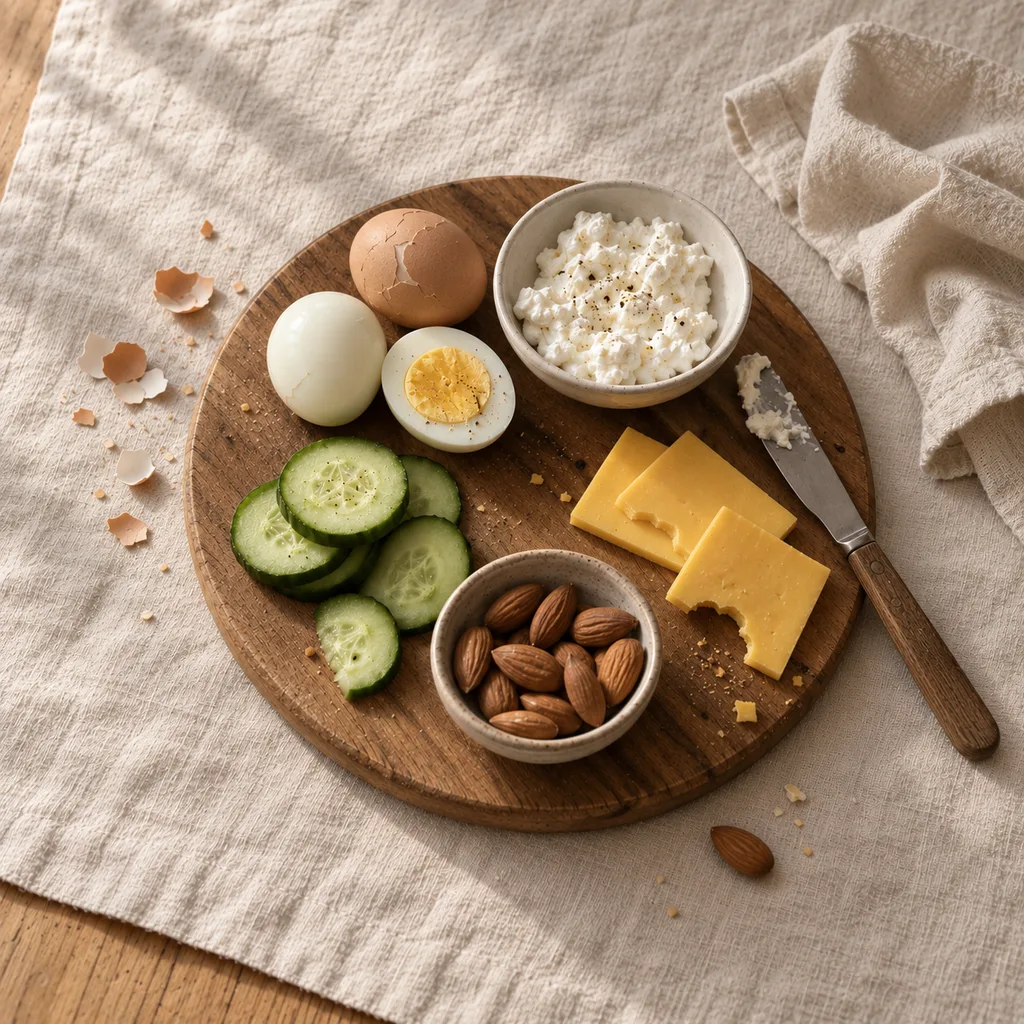
Finding high-protein low-carb snacks is easy. Finding one that holds you until dinner, without a label to decode on the way, is harder.
Most of the answers are ordinary foods: eggs, plain Greek yogurt, cottage cheese, tuna, chicken, cheese and a small handful of nuts. Below are protein and net carbs for each, taken from USDA data, plus a way to read a label when you do buy something packaged.
Our low-carb snacks guide has 30 ideas sorted by type. This page asks the narrower question: which snacks carry real protein, how much, and when a snack should really be a meal.
Before you change snacks, if you take diabetes medication
If you use insulin or a sulfonylurea, talk with the clinician who manages your medication before you reduce carbohydrate, including at snack time. Your dose was set against the way you eat now. NIDDK lists insulin, sulfonylureas, and not eating enough carbohydrate among the causes of low blood glucose, which for many people with diabetes means a reading below 70 mg/dL (3.9 mmol/L).
Nothing on this page replaces the plan your care team has given you.
How to choose protein-rich snacks for energy
“Energy” is a loose word. Here it means not being hungry again twenty minutes later. That’s the job a snack can realistically do, and it varies from person to person.
Some studies suggest protein works better spread across the day’s meals and snacks than loaded into dinner, which is one reason a protein-based snack is worth trying. It’s a reason to test it, not a rule.
A simple three-question filter covers most choices:
- Is there a real protein food in it? Eggs, dairy, fish, poultry, meat or tofu. If the protein comes from a long ingredient list, you are in label territory (see below).
- Does the carbohydrate fit your day? That depends on your own target. Our guide to how many carbs per day on a low-carb plan is the place to work that out.
- Will you actually eat it where you are? A snack that needs a fridge and a fork won’t survive the car.
If a snack passes all three and still leaves you hungry, add volume or fat: cucumber, peppers, olives, a few nuts, a drizzle of olive oil on cottage cheese.
Reading a label on a packaged snack
Packaged snacks are fine if the label survives a quick read. Four lines do most of the work:
- Serving size. The FDA says it is not a recommendation of how much you should eat. Check how many servings are in the package before you trust a big number on the front.
- Total carbohydrate and fiber. Net carbs, meaning total carbohydrate minus fiber, is a practical tool and not a regulated label term. Say how you are calculating it and stay consistent.
- Added sugars. These are listed separately from the naturally occurring sugars in milk and fruit.
- Protein per serving. Compare it with the table below. If a packaged snack carries less protein than one egg, it’s a low-carb snack, not a high-protein one.
A snack list that fits blood sugar goals: high-protein low-carb snacks compared
One qualification first: no snack list can promise a flat glucose reading for everyone. Portion, what else you ate, and your own response all matter. If you check your glucose, your readings before and after a snack tell you more than any table. Your care team sets your target range.
The foods below carry little carbohydrate relative to their protein. For the wider picture, see foods that don’t spike blood sugar, what causes blood sugar spikes, and our guide to blood sugar friendly meals.
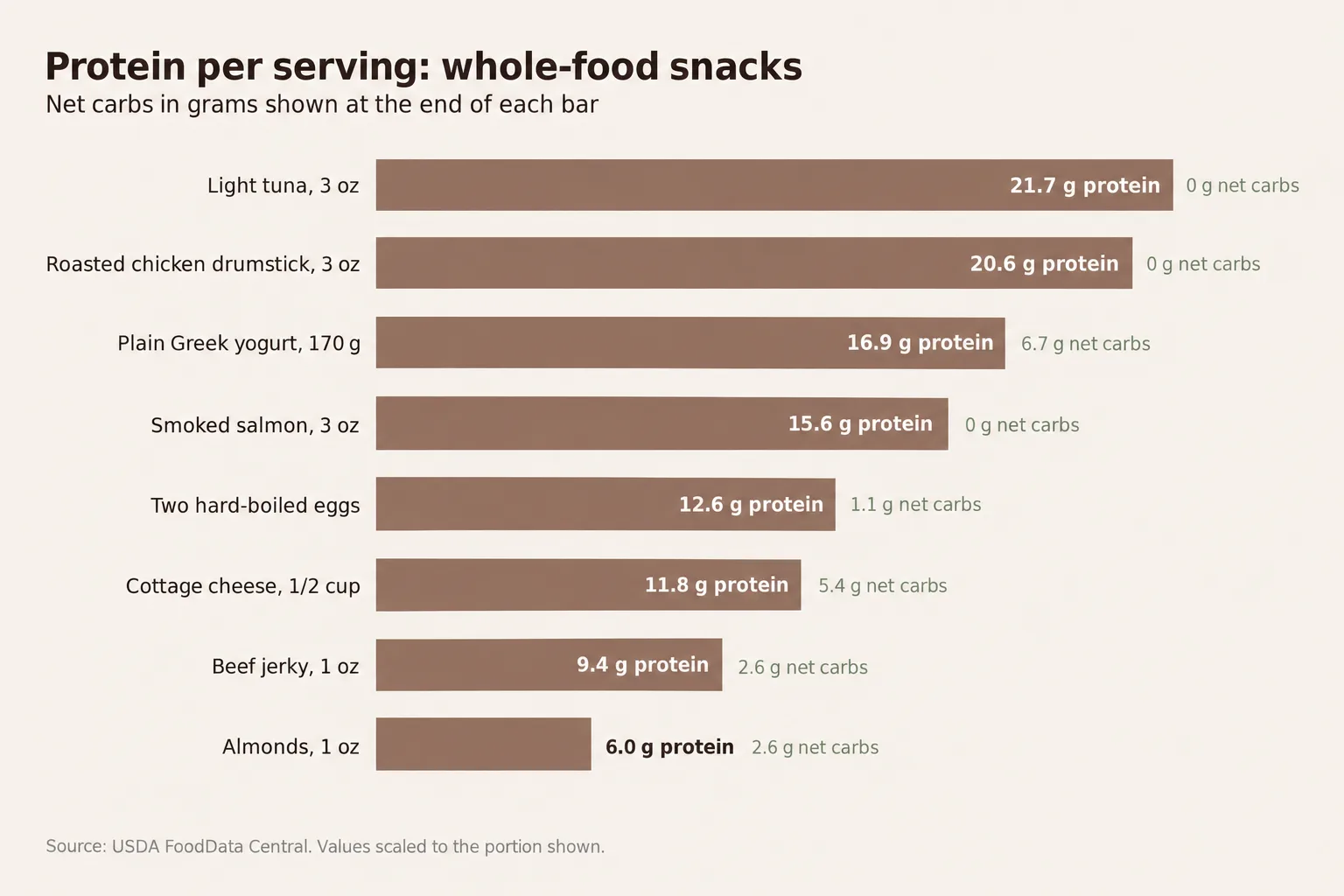
| Snack | Portion | Protein (g) | Net carbs (g) |
|---|---|---|---|
| Hard-boiled egg | 1 large (50 g) | 6.3 | 0.6 |
| Hard-boiled eggs | 2 large (100 g) | 12.6 | 1.1 |
| Plain lowfat Greek yogurt | about 3/4 cup (170 g) | 16.9 | 6.7 |
| Cottage cheese, 2% milkfat | 1/2 cup (113 g) | 11.8 | 5.4 |
| Cheddar cheese | 1 oz (28 g) | 6.5 | 1.0 |
| Part-skim mozzarella, low moisture | 1 oz (28 g) | 6.7 | 1.6 |
| Beef jerky, chopped and formed | 1 oz (28 g) | 9.4 | 2.6 |
| Light tuna, canned in water, drained | 3 oz (85 g) | 21.7 | 0 |
| Roasted chicken drumstick, meat only | 3 oz (85 g) | 20.6 | 0 |
| Smoked salmon | 3 oz (85 g) | 15.6 | 0 |
| Sliced turkey breast, packaged | 2 oz (56 g) | 8.3 | 1.2 |
| Almonds | 1 oz (28 g) | 6.0 | 2.6 |
| Roasted pumpkin seeds, no salt | 1 oz (28 g) | 8.4 | 2.3 |
| Pistachios, dry roasted, no salt | 1 oz (28 g) | 6.0 | 5.1 |
| Edamame, shelled, frozen and prepared | 1/2 cup (78 g) | 9.2 | 2.9 |
| Dark chocolate, 70 to 85% cacao | 10 g (a small piece) | 0.8 | 3.5 |
Eggs, tuna, chicken and smoked salmon carry protein with almost no carbohydrate. Dairy and nuts carry a few grams each, and flavored yogurt adds sugar on top, so plain is the version these numbers describe. Jerky is the one packaged food on the list. The USDA entry has about 500 mg of sodium and 2.6 g of sugars per ounce, and brands and flavors differ widely, so the label matters more here than anywhere else in the table. Dark chocolate is the odd one out: a treat with a little protein, not a protein snack. The USDA entry covers 70 to 85% cacao, and a higher-percentage bar can differ, so check your own label.
A word on tuna. The FDA lists canned light tuna as a Best Choice at 2 to 3 servings a week, and albacore as a Good Choice at 1 serving a week, with a serving at 4 ounces, because of mercury. So the light tuna in the table is the version to reach for. If you are pregnant or breastfeeding, or feeding young children, follow the FDA fish guidance and ask your clinician.
Where the numbers come from: USDA FoodData Central entries 173424, 170903, 172182, 173414, 171244, 167536, 171986, 172376, 173687, 170273, 172941, 170567, 170557, 170185, 168411, scaled to the portion shown. Net carbs are total carbohydrate minus fiber where USDA lists fiber. Brands, cuts and cooking change the real figures, so treat them as close, not exact.
How many grams of protein should a snack have?
There’s no single number. Anyone who gives you one for everybody is guessing.
For scale: the recommended dietary allowance for healthy adults is 0.8 grams of protein per kilogram of body weight, which Harvard Health works out to 53 grams a day for a sedentary 140-pound adult. Against that example, a 15-gram snack is roughly a quarter to a third of the day.
Most of the foods in the table land between about 6 and 22 grams a serving. Two eggs, a half cup of cottage cheese or a small cup of Greek yogurt sit in the 12 to 17 gram range. That describes the foods. It isn’t a target.
If you have kidney disease
Protein is a number for your clinician or dietitian, not for this page. NIDDK notes that some people with chronic kidney disease may need moderate amounts of protein so waste does not build up in the blood. Ask them what is right for you before you add protein snacks.
And if counting grams has ever tipped into restriction for you, skip the counting. The three-question filter above works without a number.
Quick ideas for busy days
The quickest snack is the one you prepared once. Boil six eggs, portion nuts into small containers, and keep a few cans and cheese sticks where you will see them.
- Two hard-boiled eggs. 12.6 g protein, about 1 g net carbs.
- A cheese stick wrapped in two ounces of turkey slices. About 15 g protein and 2 g net carbs, using 1 oz cheddar-style cheese. Packaged deli meat varies in sodium, so check the label.
- A can of light tuna on cucumber rounds. A 3 oz drained portion is about 22 g protein and no carbohydrate. Choose canned light over albacore (see the tuna note under the table).
- Cottage cheese with cucumber and olive oil. A half cup is about 12 g protein and 5 g net carbs before the cucumber.
- Plain Greek yogurt with almonds. About 23 g protein and 9 g net carbs, so it suits a looser carb target than the others.
- Beef jerky. One ounce is about 9 g protein and 2.6 g net carbs in the USDA entry, so it travels well. Sodium and sugar vary a lot by brand and flavor, so read the label.
- Dark chocolate with almonds. Ten grams of 70 to 85% chocolate with an ounce of almonds is about 7 g protein and 6 g net carbs. The chocolate alone has under 1 g of protein, so it needs a partner. Bars sold as no sugar still differ, so check the added sugars line.
- Leftover roasted chicken legs. A 3 oz portion of the meat is about 21 g protein and no carbohydrate. Cook extra at dinner.
Make-ahead snacks from our kitchen
Four of our recipes work as snacks. Only the first two come close to a protein snack, so pair the others with something from the table.
- Spicy jalapeño BLT bites: 8 g protein and 8 g net carbs a serving.
- Garlic parmesan baked avocado fries: 10 g protein and 6 g net carbs a serving.
- Low-carb bacon macadamia spread: 6 g protein and 4 g net carbs a serving.
- Chocolate peanut butter fat bombs: 3 g protein and 2 g net carbs each. These are a sweet-tooth option, not a protein snack.
Swapping a snack for a meal
On a busy day a snack sometimes has to stand in for a meal. It can, as long as you build it like a meal.
The gap is usually protein and volume. A one-ounce handful of almonds has about 6 grams of protein. It would take more than three ounces of almonds to match the protein in a 3 oz portion of roasted chicken leg meat, which is a lot more food. So when a snack replaces a meal, lean on the protein foods in the table, then add a vegetable and some fat.
A workable stand-in: tuna or chicken, cucumber or peppers, olives or avocado, and a few nuts. If you want a routine for this, our low-carb meal planning guide shows how to line up a few repeatable meals.
One caution for anyone on diabetes medication: NIDDK lists skipping or delaying meals among the causes of low blood glucose. If you take insulin or a sulfonylurea, ask your prescriber before you make snack-for-meal swaps a habit.
FAQ
How do I choose protein-rich snacks for energy?
Start with a real protein food such as eggs, plain Greek yogurt, cottage cheese, tuna, chicken or cheese. Add something with volume or fat, like cucumber or nuts, so it holds. “Energy” here means steady hunger between meals. Check how the snack fits your carb target and how you feel an hour later.
Which snacks fit blood sugar goals?
Eggs, fish, chicken, plain dairy and small portions of nuts carry little carbohydrate, so they are a sensible place to start. No list guarantees a flat reading, though. If you check your glucose, your own readings after a snack tell you more than any table. Your care team sets your range.
How many grams of protein should a snack have?
There is no single number. Many whole-food snacks land between about 6 and 22 grams, which describes the foods rather than setting a target. The daily guideline for healthy adults is 0.8 grams per kilogram of body weight. If you have kidney disease, ask your clinician or dietitian for your number.
What are some quick snack ideas for busy days?
Hard-boiled eggs, a cheese stick with turkey slices, a can of tuna, beef jerky, cottage cheese with cucumber, or leftover chicken legs all need almost no prep. Boil eggs and portion nuts once at the start of the week, and the fast option is already in the fridge when you are hungry.
Can I swap a snack for a meal?
Sometimes, on a busy day. A snack usually has less protein and less food volume than a meal, so build it bigger: a full portion of protein, a vegetable and some fat. If you take insulin or a sulfonylurea, skipping or delaying meals can lower blood glucose, so ask your prescriber first.
Keep it simple
Pick two protein snacks you will genuinely eat, keep them on hand, and ignore the rest of the aisle. If you want more ideas sorted by type, the low-carb snacks guide has them.
This article is general information, not medical advice. Low-carb eating can change how some medications work, particularly diabetes and blood pressure medication. Talk to your doctor or pharmacist before making a significant change to how you eat, especially if you take prescribed medication or manage a health condition.