How Many Carbs Per Day on a Low Carb Diet? A Clear Answer
There is no single number, but there are clear ranges. Here is what each one means, what it looks like on a plate, and which one to count.

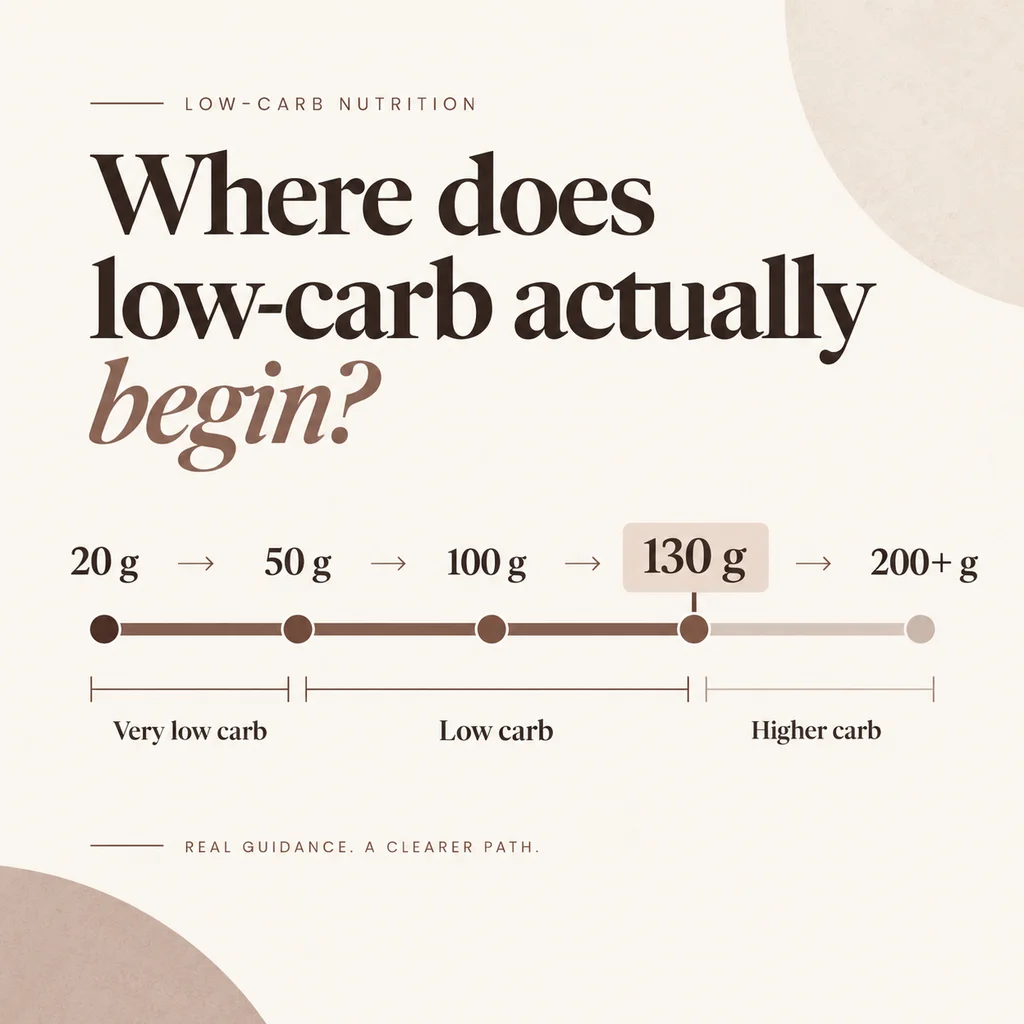
So, how many carbs per day on a low carb diet? Researchers usually call anything under about 130 grams a day low carb. Very low carb, the range keto usually aims for, is roughly 20 to 50 grams. Most people land somewhere in between, and no single cutoff is agreed on by every source.
That matters because the number people quote most often, 20 grams, is the hardest one to live with, and it is not the starting line. Lower is not automatically better. The right amount depends on your goal, your health, any medication you take, and how a given level feels by week three.
This guide gives you the ranges, shows what they look like on a plate using USDA figures, and explains which number to count.
Before you cut carbohydrate, if you take diabetes medication
NIDDK lists insulin and sulfonylureas among medicines that can cause low blood glucose, and names not eating enough carbohydrate as one of the triggers. Your dose was set against the way you eat now, so a large drop in carbohydrate without a plan can lead to low blood glucose.
A 2021 review in Frontiers in Nutrition adds that SGLT2 inhibitors carry a risk of euglycemic ketoacidosis, a form that can occur with normal glucose readings, and that very low carb eating may add to that risk.
Talk with the clinician who manages your medication before you change how much you eat, and ask what they want you to monitor. Do not adjust a dose yourself. Our guide to whether a keto diet is safe for diabetics covers more of the picture.
How many carbs per day on a low carb diet? The ranges
Think in ranges rather than one number. These groupings are practical descriptions, not medical rules, and the published definitions overlap.
| Daily carbohydrate | What it usually means |
|---|---|
| 100 to 130 g | A gentle reduction, and low carb by the common research boundary of under 130 g |
| 50 to 100 g | A clearer low-carb pattern, with less room for starch and sugar |
| 20 to 50 g | Very low carb, the range keto usually targets |
| Under 20 g | Very restrictive, and not a place to start |
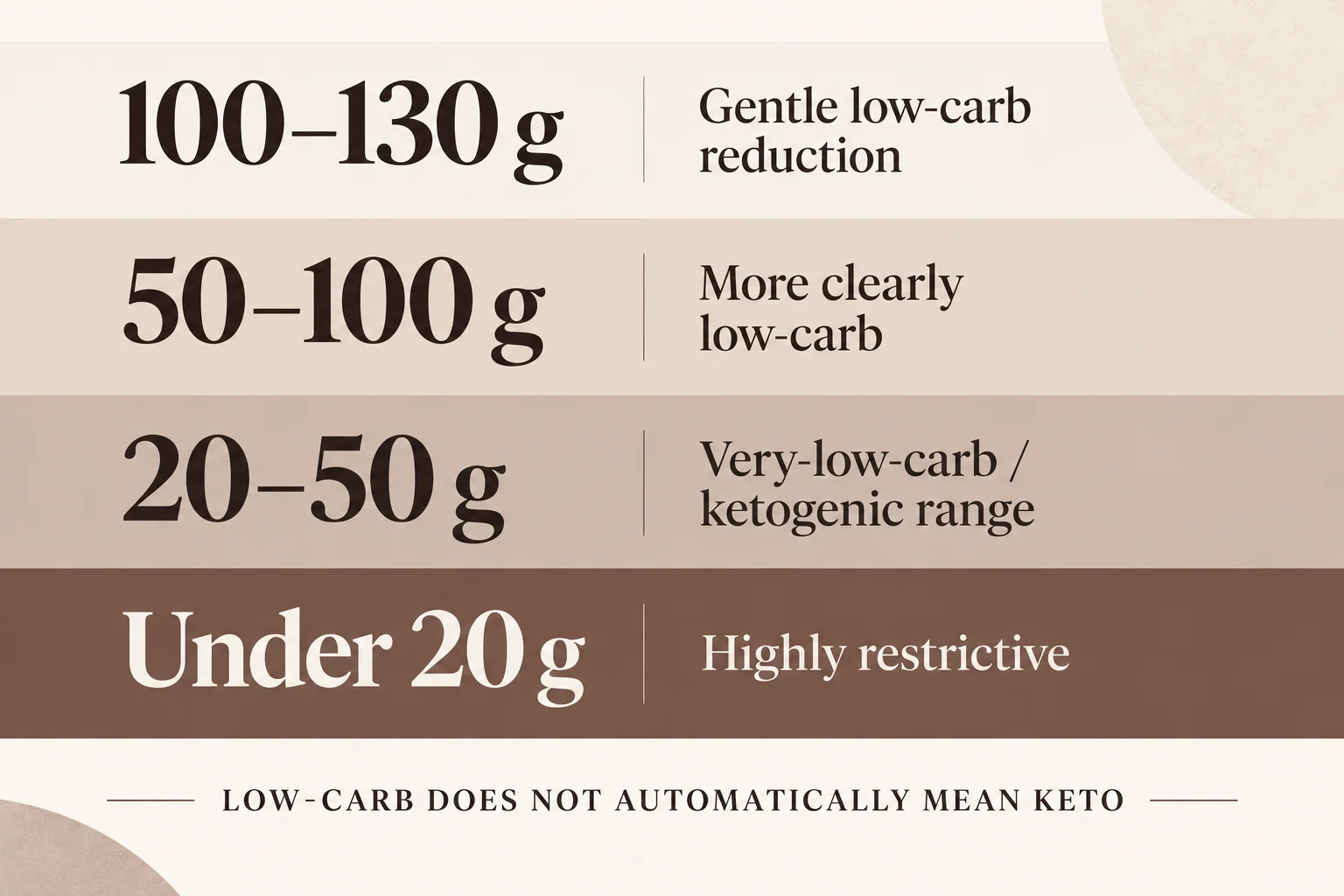
A 2024 review in Current Nutrition Reports describes low-carbohydrate diets as 50 to 129 grams a day and very-low-carbohydrate or ketogenic diets as 20 to 50 grams. Other papers draw the low-carb line a little differently, which is why the ranges above overlap.
Key takeaway: You do not have to eat keto to eat low carb.
Why 130 grams keeps showing up in low-carb definitions
You will see 130 grams in a lot of low-carb research, and it is worth knowing what it is and is not.
A 2023 paper in Frontiers in Nutrition argues that low-carb diets should be defined by grams rather than percent of calories, because calorie intake changes the percentage. It proposes fewer than 130 grams a day as the threshold, a line that matches the Recommended Dietary Allowance for carbohydrate.
- It is a classification tool. It does not mean 129 grams is low carb and 131 is not.
- It is a boundary for researchers comparing studies, not a target you have to hit.
- For you, the size of the change matters more. If you eat 250 grams today, moving to 120 grams roughly halves your intake, which is a substantial shift.
Do you need to go as low as 20 to 50 grams?
No. Twenty to 50 grams is the very-low-carb, or ketogenic, range. It is one option, not the entry requirement for a low-carb diet.
100 to 130 grams may be enough when you want to…
- Cut back on refined carbohydrate
- Drop sugary drinks and snacks
- Improve the quality of your meals
- Make a first change you can realistically keep
50 to 100 grams leaves less room for starch and sugar
At this level the first things to go are the concentrated sources: sugary drinks, sweets, and large portions of bread, cereal, pasta and rice. The numbers add up fast. One cup of cooked white rice is about 45 grams of total carbohydrate by USDA data, which is nearly half of a 100-gram day in a single side dish.
20 to 50 grams is a different level of restriction
Eating this way may lead your body to make ketones from fat, a state called nutritional ketosis. Ketosis is one possible outcome, not a requirement for choosing a lower-carb pattern.
It also is not a switch. The same 2024 review notes a ketogenic diet limits carbohydrate to under 50 grams a day, but the level where ketosis starts can vary from about 20 to over 70 grams between people, based on their ketone levels.
What carb level can you actually live with?
A better question than "what is the lowest I can go?" is "what level helps with my goal and still fits my week?"
A carb target should be low enough to matter and loose enough to keep. A number you can hold for months tends to do more for you than a stricter one you drop in week three.
That points to a gradual approach. If you eat 250 grams now, you do not have to jump to 30. A drop to 120 is already a major dietary change. Hold it, see what happens, and go lower only if you have a reason to.
If you have been through strict rules and rebound before, that history matters more than any range in this article. It is a reason to start higher, not to try harder.
Total carbs or net carbs: which number should you count?
This trips up a lot of people, so it is worth settling before you count anything.
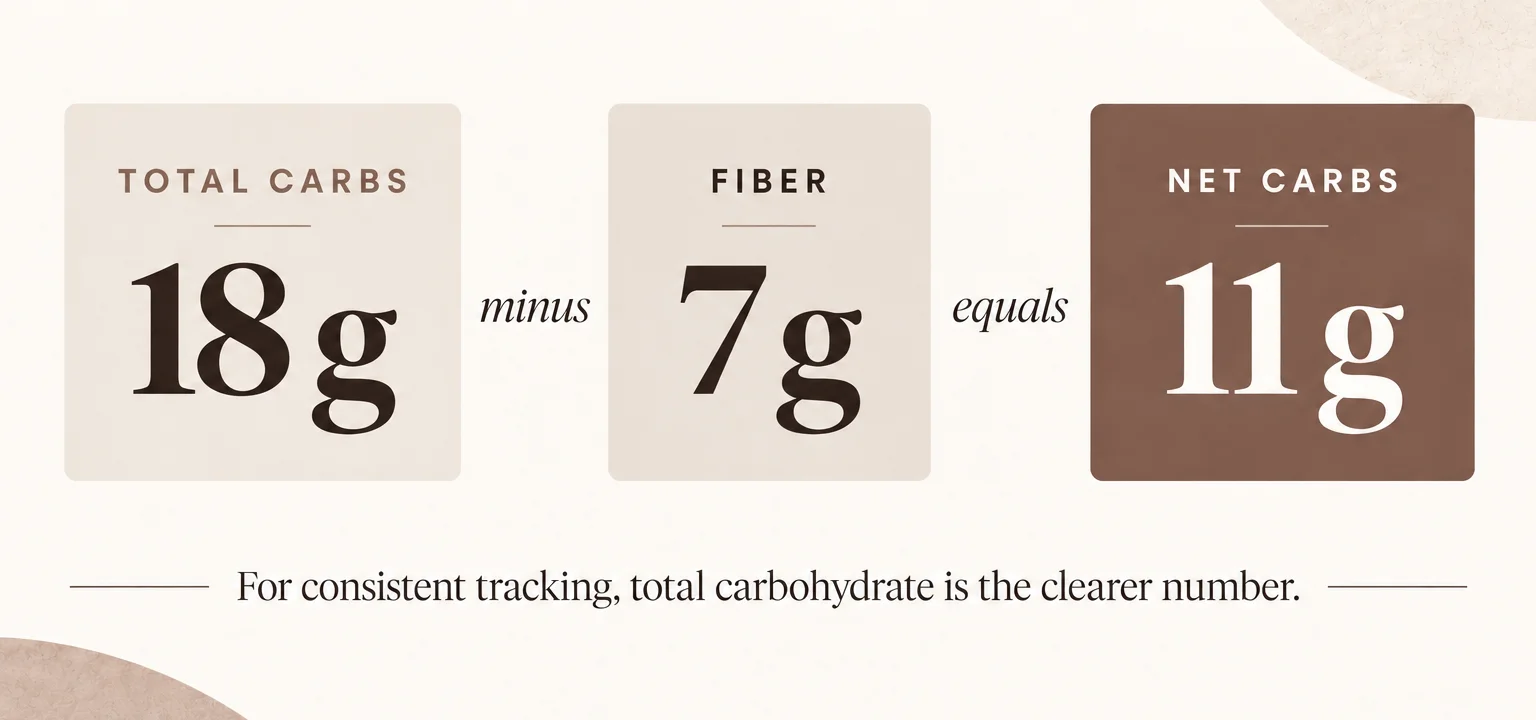
Total carbohydrate is the number on the label. The FDA's Nutrition Facts panel lists total carbohydrate, with dietary fiber shown beneath it.
Net carbs are usually calculated as total carbohydrate minus fiber. Some people also subtract some or all sugar alcohols.
The catch is that there is no FDA-approved definition of net carbs, so companies calculate it differently. The American Diabetes Association's Diabetes Food Hub recommends using total carbohydrate on the label.
So if you want a consistent number, count total carbohydrate. If you would rather count net carbs, choose one method and apply it to every food. As an example, one cup of raw chopped broccoli is about 6 grams total and 2 grams fiber, so roughly 4 grams net. Treat the ranges in this article as approximate either way.
Where your carbs come from still matters
Having 80 grams available does not mean 80 grams of sweets fits the goal. The number matters, and so does what the carbohydrate comes with and what it replaces.
Carbohydrate that tends to make a low-carb day easier to run:
- Non-starchy vegetables
- Berries or other fruit you tolerate
- Plain dairy
- Nuts and seeds
Carbohydrate that uses up the budget fast:
- Sugary drinks
- Sweets and pastries
- Refined cereal
- Large portions of bread, pasta and rice
- Ultra-processed "low-carb" products
These are USDA FoodData Central values, calculated per serving. Brands and portions vary, so check the label on what you actually buy.
| Food | Serving | Total carbohydrate |
|---|---|---|
| Cooked white rice | 1 cup | about 45 g |
| Cola | 12 fl oz can | about 38 g |
| Cooked spaghetti | 1 cup | about 38 g |
| Baked russet potato | 1 medium | about 37 g |
| Banana | 1 medium | about 27 g |
| Orange juice | 1 cup | about 26 g |
| Blueberries | 1 cup | about 21 g |
| White bread | 1 slice | about 14 g |
| Plain nonfat Greek yogurt | 1 container (170 g) | about 6 g |
| Almonds | 1 oz | about 6 g |
| Raw broccoli | 1 cup chopped | about 6 g |
If sweet foods are the sticking point, our guide to breaking the sugar habit works on the pull rather than the plate, and emotional eating covers the times when hunger is not the trigger.
What does 100 grams of carbs actually look like?
Carbohydrate adds up faster than most people expect. Here is one way a 100-gram day can be divided. It is an illustration of a budget, not a meal plan.
- Breakfast: 15 to 20 g
- Lunch: 20 to 25 g
- Dinner: 25 to 30 g
- Dairy, nuts, vegetables, berries and extras: 20 to 30 g
That comes to roughly 80 to 105 grams.
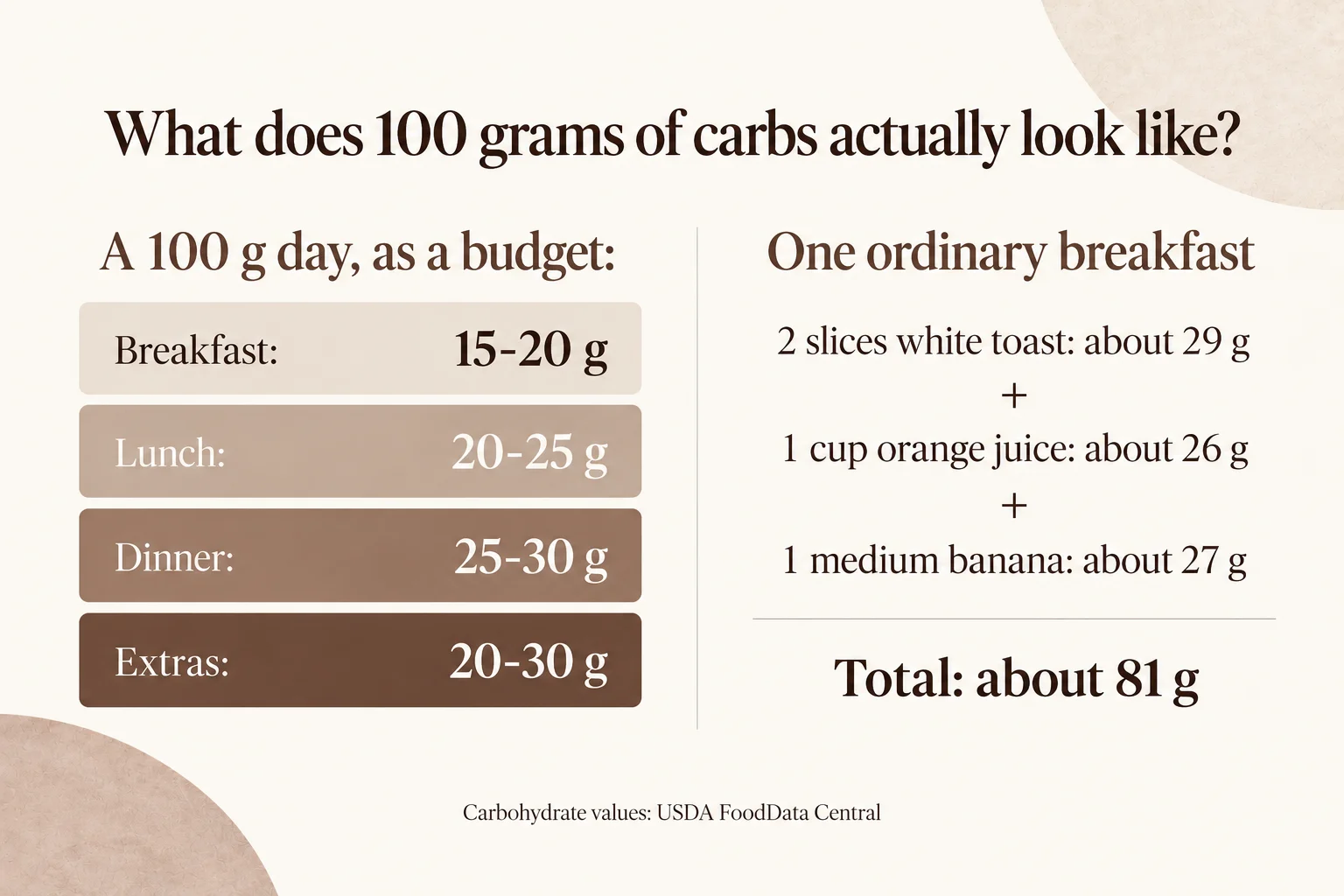
Now compare an ordinary breakfast. Two slices of white toast, a cup of orange juice and a medium banana come to about 81 grams by USDA figures. Nothing in that breakfast is unusual, and it is already most of a 100-gram day.
A container of plain nonfat Greek yogurt with an ounce of almonds is about 12 grams. Add half a cup of blueberries and you are still inside a 15 to 20 gram breakfast budget.
That is how someone can pass 130 grams without eating anything that looks like junk food.
How to find your own carb target
Start at a reasonable level, hold it steady for a couple of weeks or so, then read the signals. One good or bad day tells you very little.
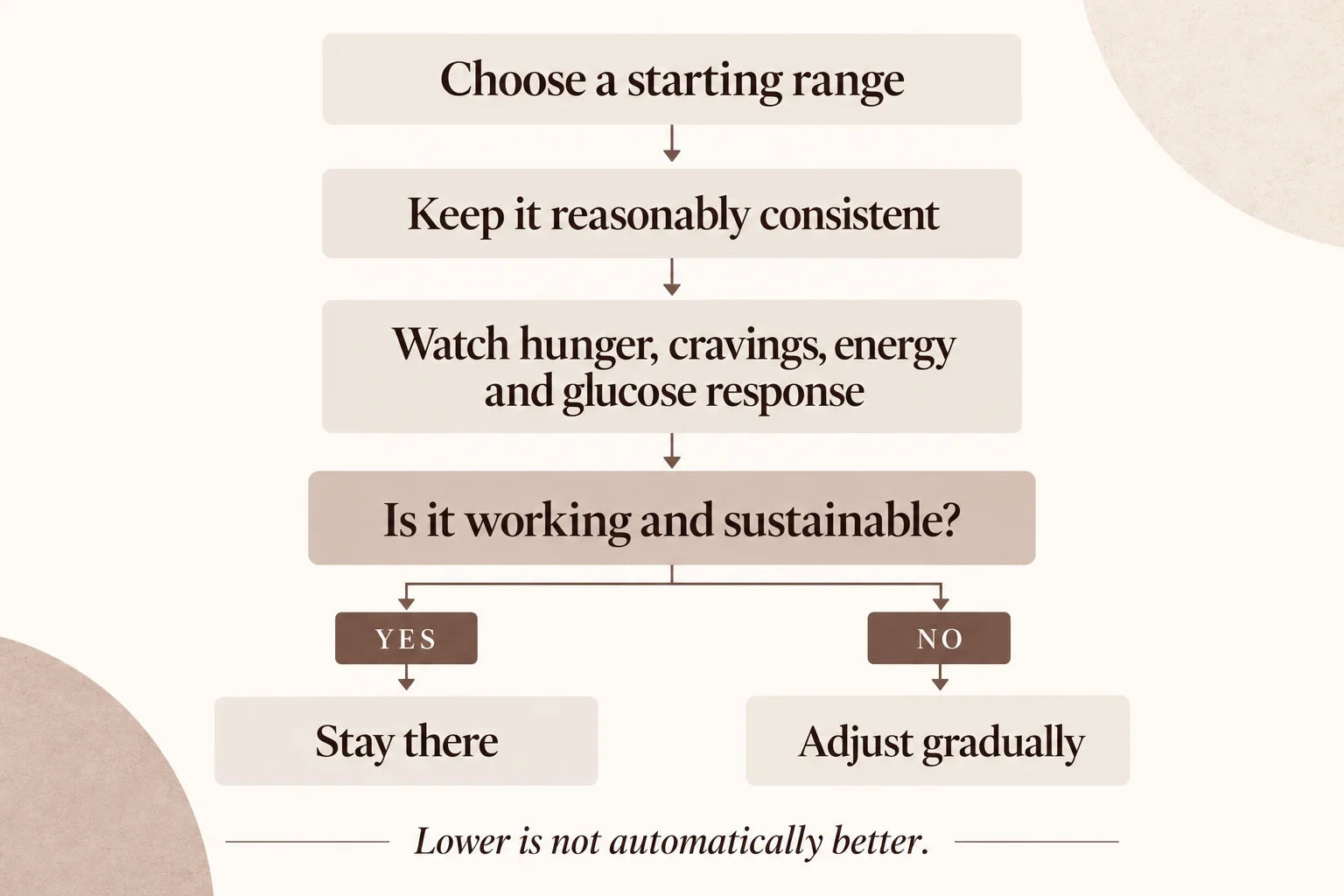
- Hunger between meals. Are you getting through to the next meal comfortably?
- Cravings. Are they quieter, the same or louder?
- Energy. Does it hold through the afternoon?
- Satisfaction. Do meals feel like enough?
- Digestion. Has anything changed, for better or worse?
- Sustainability. Could you eat this way in a busy week, not just a calm one?
- Blood glucose response, if you already monitor it with your clinician's guidance.
- Weight or waist, if that is one of your goals. Both move slowly and unevenly.
Some signals show up within days and others take months, which is covered in our guide to the insulin resistance diet. If your energy dips after meals, what causes blood sugar spikes lists other triggers worth ruling out before you cut carbs further.
Key takeaway: The lowest number is not automatically the best number.
Low carb vs keto: they are not the same thing
Low carb is usually defined as under about 130 grams a day. Very low carb, or keto, is commonly 20 to 50 grams and is intended to make nutritional ketosis more likely. Keto is one way of eating low carb. It is not the definition of it.
If you are weighing the two, we compare them in low-carb Mediterranean diet vs keto, and what is the ketogenic diet covers the stricter end. Or start with the simplest change: our guide to foods that don't spike blood sugar is a good first shop.
Who these ranges are not written for
These ranges are general information for healthy adults. Some situations need a clinician's input before any carbohydrate target makes sense.
- Pregnancy, breastfeeding and children. This article does not give carbohydrate targets for these groups. Talk with your doctor or midwife first.
- Kidney disease, liver disease or thyroid medication. Changing how you eat can interact with each of these. Ask your clinician before you begin.
- A history of disordered eating. Gram targets can turn into rules that take over. If counting starts to feel like it is running you, put the numbers down and talk with a professional.
Common questions
Is 100 grams of carbs a day low-carb?
By the most common research definition, yes, because it falls under about 130 grams a day. It is a moderate low-carb level rather than a strict one. It leaves room for some fruit, dairy and a starch portion, and it sits well above the 20 to 50 gram range that keto usually targets.
Is 50 grams of carbs a day considered low-carb?
Yes. Fifty grams sits at the top of the very-low-carb range that keto usually targets, so it counts as low carb by any common definition. Whether it puts you in ketosis varies, because the carb level where ketosis starts differs from person to person.
How many carbs should I eat to lose weight on a low-carb diet?
There is no single number that works for everyone. Weight change depends on total intake, food quality, sleep, activity and medication, not carbs alone. A practical start is a level you can hold for a few weeks. Watch hunger and energy alongside the scale, and lower it only if you need to.
Do I count total carbs or net carbs?
Total carbs is the steadier choice. It is the number on the label, and there is no FDA-approved definition of net carbs. The American Diabetes Association recommends using total carbohydrate on the Nutrition Facts label. If you prefer net carbs, pick one method, use it for every food, and keep it.
Can I eat 100 grams of carbs and still be in ketosis?
For most people, probably not. A 2024 review describes the ketogenic range as under 50 grams a day, while noting the level where ketosis starts varies from about 20 to over 70 grams between people. A hundred grams sits above even that upper figure. Measuring ketones is the only way to know for certain.
Do vegetables count toward my daily carb total?
Yes. Vegetables contain carbohydrate, and they count like any other food. Non-starchy ones add up slowly: a cup of raw chopped broccoli is about 6 grams of total carbohydrate, or about 4 net, using USDA data. Starchy vegetables count for more. A medium baked russet potato is about 37 grams.
Find the number that fits you, then keep it in your pocket.
A starting point is easier to choose when you have your own figures in front of you. Try the free calculator for an estimate, and keep the carb count cheat sheet nearby while you shop. If you want to build the plan on paper, the Leave the Carbs planner is there for that.
Try the free keto calculator →Get the free carb count cheat sheet
This article is general information, not medical advice. Low-carb eating can change how some medications work, particularly diabetes and blood pressure medication. Talk to your doctor or pharmacist before making a significant change to how you eat, especially if you take prescribed medication or manage a health condition.
Sources
- Nutritional Considerations During Major Weight Loss Therapy: Focus on Optimal Protein and a Low-Carbohydrate Dietary Pattern. Volek, Kackley and Buga, Current Nutrition Reports, 2024
- Applying a nutrition security lens to the Dietary Guidelines for Americans to address metabolic health. Frontiers in Nutrition, 2023
- Daily Value on the Nutrition and Supplement Facts Labels. U.S. Food and Drug Administration
- Nutrition-Related Claims You Should Know About. American Diabetes Association, Diabetes Food Hub
- Low Blood Glucose (Hypoglycemia). National Institute of Diabetes and Digestive and Kidney Diseases
- Adapting Medication for Type 2 Diabetes to a Low Carbohydrate Diet. Cucuzzella, Riley and Isaacs, Frontiers in Nutrition, 2021
- Carbohydrate values per serving: USDA FoodData Central, SR Legacy dataset